The Evolution of Bitcoin Mining: From CPU to ASIC
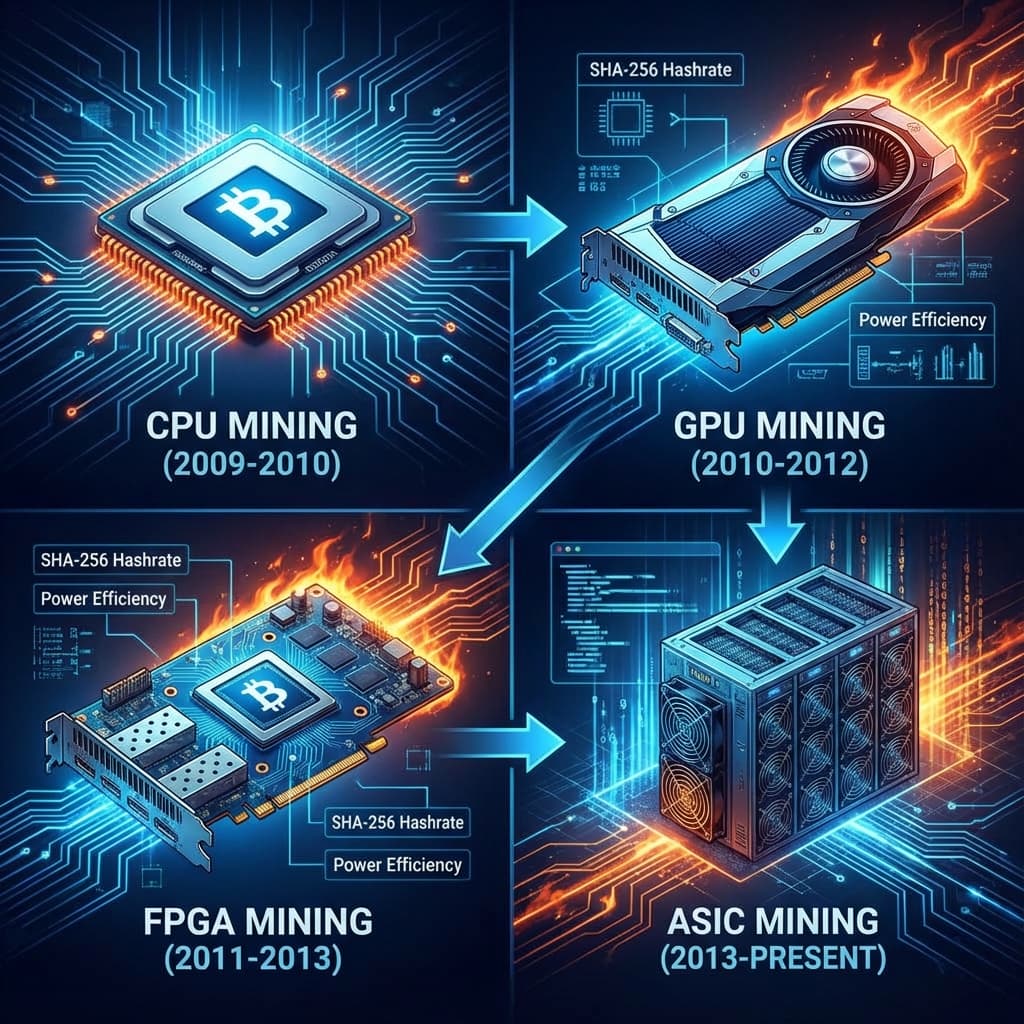
Bitcoin mining has come a long way since Satoshi Nakamoto mined the genesis block on a standard CPU in 2009. The evolution of mining hardware is a testament to the rapid growth and increasing security of the Bitcoin network.
The CPU Era (2009 - 2010)
In the beginning, anyone could mine Bitcoin using their personal computer's Central Processing Unit (CPU). The network difficulty was low enough that a standard laptop could find blocks. This was the era of true decentralization, where "one CPU, one vote" was a reality.
The GPU Era (2010 - 2011)
Miners soon realized that Graphics Processing Units (GPUs), designed for parallel processing, were much more efficient at hashing SHA-256. Laszlo Hanyecz (famous for the Bitcoin Pizza purchase) is credited with being one of the first to use GPUs for mining. This shifted the landscape, making CPU mining obsolete.
The FPGA Era (2011 - 2012)
Field-Programmable Gate Arrays (FPGAs) offered a short-lived bridge between GPUs and ASICs. They were more power-efficient than GPUs but were difficult to configure and manufacture at scale.
The ASIC Era (2013 - Present)
Application-Specific Integrated Circuits (ASICs) changed everything. These chips are designed solely to mine Bitcoin. The release of the Avalon 1 in 2013 marked the beginning of the industrial mining era. Today, mining is dominated by powerful ASICs from manufacturers like Bitmain, MicroBT, and others.